Animals A to Z Alphabet Learning System

Help your child master letters, sounds, and early reading with our complete Animals A to Z collection. This research-backed phonics system uses animal-shaped letters and consistent visual cues across every product, making alphabet learning intuitive, joyful, and effective for preschool through first grade.

Each letter pairs with an animal whose shape mirrors the letterform—like Vulture with wings spread wide forming a V. These visual connections help children retain letter shapes and sounds faster than traditional methods. Whether you're looking for Montessori-inspired materials, homeschool phonics curriculum, or screen-free learning activities, this collection works as a cohesive system or as individual tools.

Perfect for ages 3-7. Designed by a homeschool mama in collaboration with early educators.

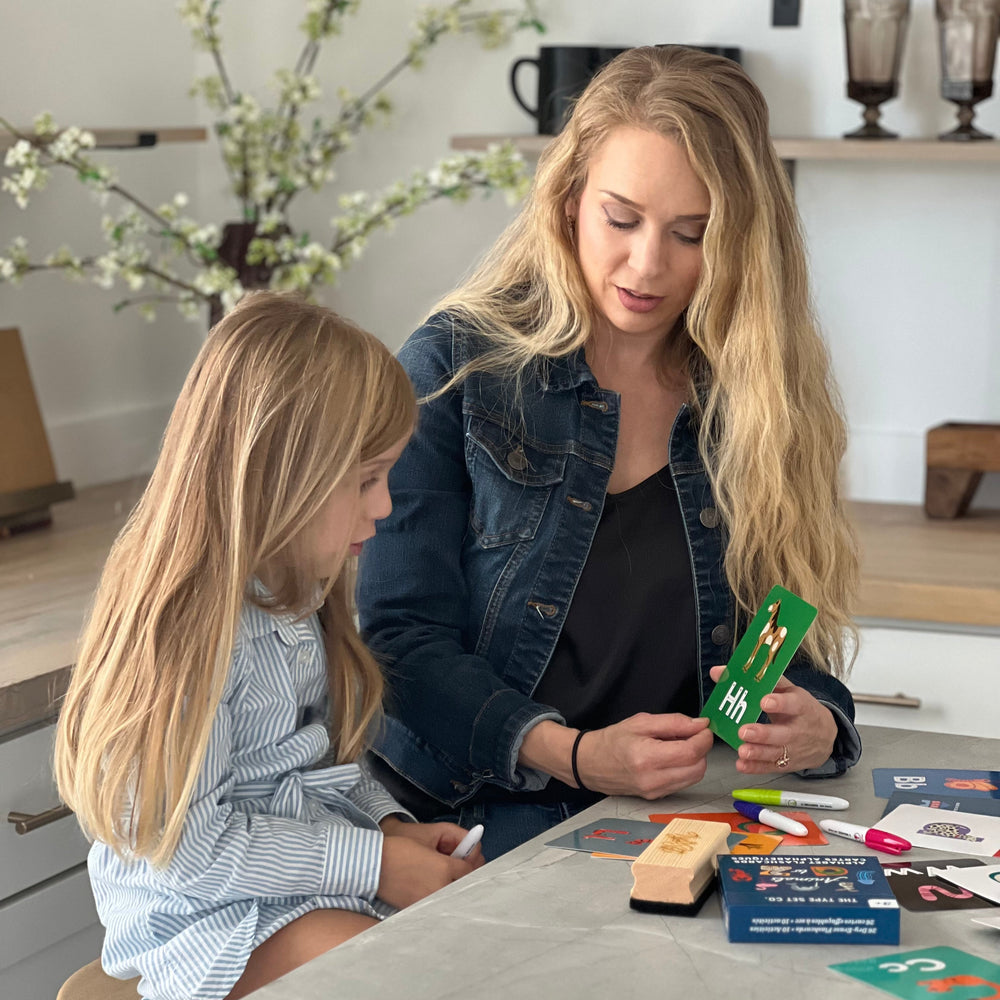
Woman and child playing with alphabet flashcards on a table in a kitchen

What Makes Animals A to Z Different

Our alphabet learning system is built on research-backed principles that help children learn letters faster and retain them longer. Here's what sets this collection apart:

Child holding alphabet flashcards

Lowercase First, Reading Ready

We prioritize lowercase letters because that's 95% of what children see in books. Uppercase is included for name recognition and capitalization concepts, but lowercase leads—helping children connect letter shapes to the sounds they'll use most often

Scattered animal alphabet flashcards featuring animals shaped like lowercase letters and traceable upper and lowercase letterforms.

Animal-Shaped Letters

Each letter pairs with an animal whose body forms the letter shape—like Snake slithering in an S-curve. These visual connections help children retain letter forms faster and more effectively than traditional alphabet instruction.

Three childen playing animal alphabet memory matching game on living room floor.

Phonics-Forward Strategy

This isn't just letter naming—it's phonics instruction. Every product emphasizes the sound each letter makes, building phonemic awareness and decoding skills that lead directly to reading CVC words like "cat," "run," and "sit."

Child matching foam letters with a colorful children's alphabet book on a wooden surface

Complete Multi-Sensory System

Children hear letter sounds through the storybook's rhyming storyline, trace them on flashcards, build words with magnetic letters, match them in games, and practice with stickers. This repetition across formats creates multiple neural pathways for stronger, faster literacy development.

Child reading a an alphabet storybook on a blue blanket with alphabet flashcards cards scattered around

⭐️⭐️⭐️⭐️⭐️

The only alphabet book your child needs

This is a delightful, content-packed educational book for kids. It hits the standard for a great kids' book—the rhymes have a great cadence, it's easy to read aloud, and the illustrations are bright and cheery. But more than that, it packs a ton of education into each page and can be a favorite for such a wide age range.

About the Creator

Ashley Jankowski is a professional graphic designer, photographer, homeschool mama, and children's book author. Before founding The Type Set Co. in 2016, she ran a branding and packaging design firm for over a decade.

The Animals A to Z collection was developed in collaboration with early educators to expand our bestselling modern magnetic letters into a complete alphabet learning system.

Each product reflects her belief that well-designed learning tools should be as functional as they are inspiring—helping children understand letter sounds through fun, colorful, screen-free activities that spark joy and discovery.

FAQs

Our alphabet learning system is designed for children ages 3-7 (PreK through 2nd grade), but can be used earlier or later depending on your child's learning stage. Younger children (3-4) often start with the storybook and magnetic letters for letter recognition and exploration. Older preschoolers and kindergarteners love the flashcards for phonics practice and the matching game for reinforcement. First and second graders use the collection for spelling, handwriting practice, and reading fluency. The multi-sensory approach meets kids wherever they are.

Three key differences: First, the consistent animal mnemonic system across every format (book, cards, magnets, stickers, game) creates connected learning instead of isolated activities. Second, the design is intentionally beautiful and modern—these are materials you'll want displayed in your home, not hidden in a closet. Third, every product is tactile and screen-free, supporting the focused, hands-on learning that builds strong literacy foundations. This isn't a worksheet program or an app. It's a thoughtfully designed system that respects how children actually learn.

Each letter pairs with an animal whose body forms the letter shape—like Snake slithering in an S-curve or Vulture with wings spread forming a V. These visual connections help children remember letter shapes and sounds faster than traditional alphabet instruction. When kids see the letter S, they instantly recall Snake and the /s/ sound. It's a simple but powerful memory tool that makes abstract letters concrete and memorable. This strategy is also called Embedded Pictographic Mnemonics.

Three things: First, the animal-shaped letter system is consistent across every product (book, flashcards, magnets, game, stickers), so learning builds on itself instead of starting over with each tool. Second, we prioritize lowercase and phonics from the start—not just letter naming. Third, the design is modern and beautiful enough to display proudly, not hide in a closet. These are learning tools you'll actually want to use every day.

Both. Homeschool families use the collection as a complete alphabet and phonics curriculum for PreK and Kindergarten. The storybook introduces letters and sounds, flashcards provide structured lessons, and magnetic letters support hands-on word building. Teachers love the flashcards for small group instruction, the matching game for literacy centers, and the stickers for independent practice. Everything is reusable, durable, and screen-free—perfect for any learning environment.

Not at all. While the collection works beautifully as a complete system, each product stands alone. Many families start with the Curious Creatures storybook and add flashcards or magnetic letters later. Teachers often use just the flashcards for phonics instruction or the matching game for literacy centers. The consistent animal theme across all products means they coordinate seamlessly when you're ready to expand, but there's no requirement to purchase everything at once.

For letter recognition (ages 3-4), start with the Curious Creatures storybook and magnetic letters. For phonics instruction (ages 4-6), add the flashcards. The matching game works well once kids recognize 10-15 letters and are ready for independent play. Restickable stickers are great for handwriting practice and creative play at any stage. Most families start with 2-3 products and expand as their child progresses—there's no "right" order.

Absolutely. The collection meets kids wherever they are. If your child knows uppercase but struggles with lowercase, the flashcards and magnets will bridge that gap quickly. If they're working on letter sounds, the storybook and matching game reinforce phonics. If they're ready for word building, the magnetic letters and stickers support spelling and writing. The multi-sensory approach strengthens existing knowledge while filling in gaps.

The 130-piece set is weighted for real-world word building. You get 4 each of high-frequency letters like a, e, i, o, and u because kids need multiples to spell common words like "ball," "apple," and "look." Less common letters like q and z come with 2 each. There's 1 uppercase of every letter (perfect for names) and weighted lowercase for reading and spelling practice. This means kids can build dozens of real words without running out of the letters they use most.

Lowercase first—or both together. Here's why: 95% of the text in books is lowercase, so that's what children need to recognize for actual reading. Our collection prioritizes lowercase across all products because it supports phonics and reading fluency faster. Uppercase is included for name recognition and capitalization, but we lead with lowercase because that's what gets kids reading. If your child already knows uppercase, the transition to lowercase happens quickly with our visual animal cues.